

In the mid-2000s, after the dot-bomb and thousands of failed technology projects and cost overruns, companies invested heavily in PMOs and PPM tools. They learned to review, rank, and prioritize project activity, track budgets carefully, and match spend to outcomes.
Then Agile happened.
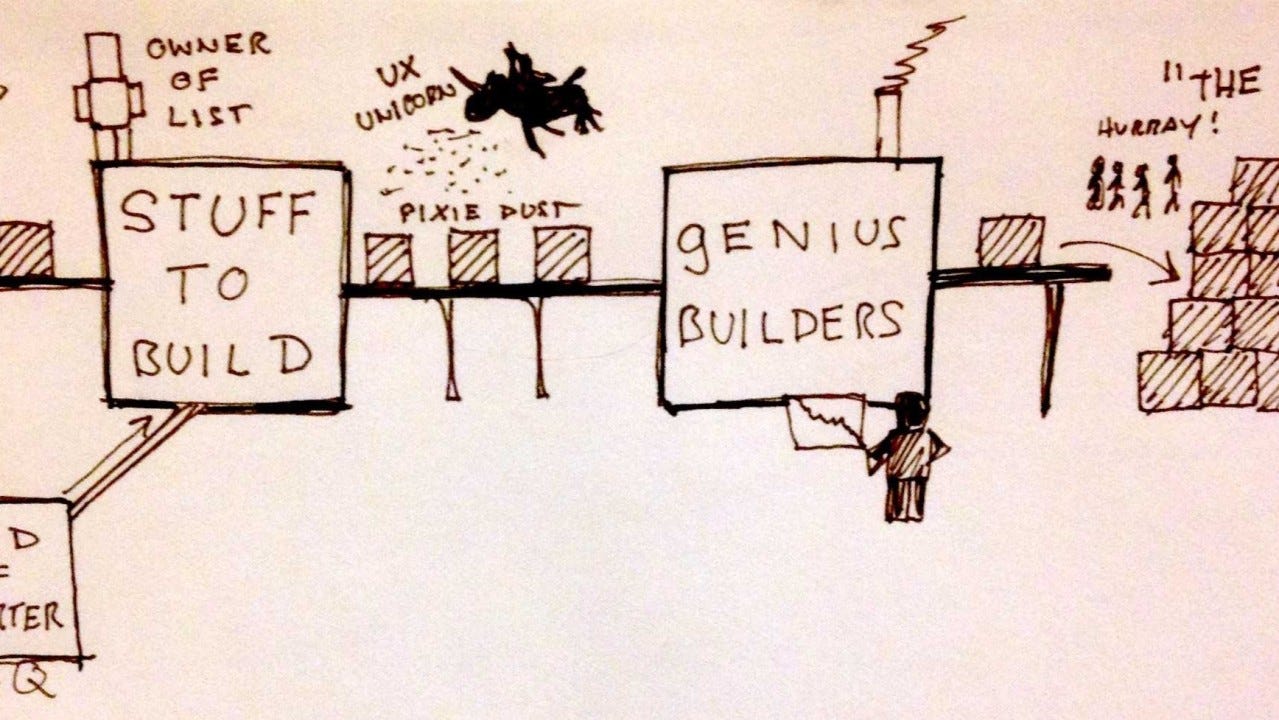
The original illustration of a “Feature Factory” posted with John Cutler’s 2016 article.
Agile was a factory-line revolt. Developers were tired of PMs, especially non-technical PMs, telling them what to do, demanding status reports, tracking their activity, and so on. All evidence from the software industry indicated that Agile delivery was more productive than the PM-directed waterfall method. And so developers made their case, and mostly won. Enterprise shops converted to Agile, to working against backlogs, to pushing code regularly and to continuous updates.
Agile is a more productive way to write software. And so we might assume the story ends here. PMOs shrank or disappeared, development shops got more productive, hooray the end.
There’s a problem though, and it’s this: Agile made shops better at What and How. It made them worse at Why and When. John Cutler named the symptoms a decade ago in 12 Signs You’re Working in a Feature Factory — no measurement of impact, success theater around shipping, roadmaps that list features instead of outcomes. In the last decade, none of that has changed.
I will now repeat the first two sentences of the post.
Agentic AI is the first enterprise technology wave in twenty years that will demand project portfolio management (PPM) discipline. But most companies do not have PPM discipline anymore.
AI agents cross system boundaries, touch multiple business processes, create dependencies between teams that don’t talk to each other, and produce outcomes that sprint metrics cannot measure. You cannot run an agentic AI program out of a backlog. You need management intelligence that can see across initiatives, kill the ones that won’t work, reallocate budget mid-flight, and hold the line on outcomes.
That capability used to be standard. It isn’t anymore.
Project Portfolio Management died after Agile and nothing replaced it. Project management itself got handed to functional leads who never trained for it — PMI’s own data shows fewer than half of projects today are led by formally trained PMs. Deloitte has been blunt about the mechanism: when organizations moved to continuous backlog reprioritization, the link between portfolio decisions and team delivery broke, and most enterprises never rebuilt it.
Walk into a large enterprise and ask who is working on what, and why. You will not get a clean answer. You will get a Jira export, a slide from last quarter’s OKR review, and a functional lead who can describe their team’s sprint but not how it ladders to anything.
Now layer agents on top of that. Cross-functional. Cross-system. Outcome-dependent. The mismatch between what agentic AI requires and what most enterprises can actually execute is the real adoption problem — bigger than model selection, bigger than vendor choice, bigger than the infrastructure debates that dominate the conversation.
The companies that get agentic AI done will be the ones that rebuild portfolio and program management before the budget overruns force them to. Gartner is already projecting 40% of agentic AI projects will be cancelled by 2027. That number is not about the technology. It is about execution capacity that was dismantled fifteen years ago and has not been reinvented.
The work ahead is unglamorous: real PMs, real portfolio governance, real outcome accountability. The firms that do it quietly, now, will be running production agents while their competitors are still reorganizing. Agile didn’t kill PPM. We did. The good news is we can rebuild it — and the ones who do first will win the race to agentic success.